
Does your dog absolutely lose their mind every time the doorbell rings? You’re not alone.
The good news – you can train your dog to ignore the doorbell using calm, positive techniques that actually work.
Can you train a dog to ignore the doorbell?
Yes. Any dog can learn to ignore the doorbell with the right training approach.
The most effective methods are based on:
Desensitisation (reducing their reaction to the sound)
Positive reinforcement (rewarding calm behaviour)
Together, these techniques have been shown to reduce strong reactions to loud noises.
Essentially, your dog will learn that the doorbell isn’t such a big deal that they need to engage ‘attack’ mode. This is the desensitisation part. And, for the positive reinforcement portion, they’ll learn that they’ll get an even bigger reward for doing something other than barking when the doorbell rings.
How long does doorbell training take?
Doorbell training takes time and repetition. Most dogs need daily practice, short sessions (around 10 minutes), and at least one week to start seeing improvement.
Some dogs will take longer, especially if they’ve been rehearsing their doorbell meltdown for years.
A few key tips to remember before you get started:
No matter if you’ve got the loudest dog on the block, you can train your dog to ignore the doorbell. But, you’ll make the process much easier by sticking with the following tips:
- Set the tone (aka. stay calm at all times).
Perhaps the most important thing that you can do while training your dog is to remain calm. If your dog is barking at the doorbell because they’re startled, anxious about the unknown visitor, or wildly excited, you raising your voice at them is like fuel on the fire. So, do your best to lower the volume, resist the urge to punish your dog, and stick to the steps.
- Set aside time, daily, during the first week.
Just like you might struggle to get back to work after a long weekend, your dog will have a hard time remembering their training after a long gap. So, when you’re ready to train your dog to ignore the doorbell, be ready to work on it for about ten minutes every day for at least a week.
- Be consistent.
Whether you’re on day one or week 12 of trying to train your dog to ignore the doorbell, you want to make sure that you stick to the training every time the doorbell rings. As we covered in our article, How to Avoid Confusing Your Dog, consistency is a key way for your dog to make associations during training.
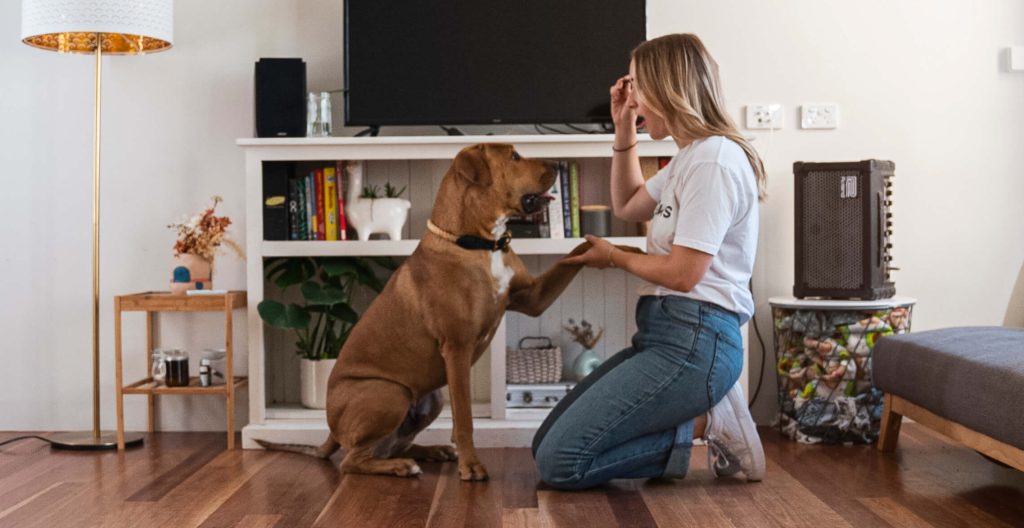 Step-by-Step: How to train your dog to ignore the doorbell
Step 1: Desensitise your dog to the doorbell sound
Hopefully your doorbell ring is a pleasant sound, because you’re going to be hearing it a lot! The goal is to ring the doorbell any chance you get:
- Before walks
- When you arrive home
- While your dog is eating
- Randomly throughout the day
You can also play a recording of your doorbell on your phone.
The goal: Your dog learns that the doorbell does not always mean strangers at the door. At first, your dog will probably bark anyway. Ignore the behaviour and keep going.
Step 2: Teach your dog what to do instead
It’s easier to replace a behaviour than remove one entirely. Instead of barking, your dog needs a clear alternative. So, you’re going to teach your dog another way to react to the doorbell ringing that doesn’t include turning into a furry Hulk!
Teach a specific “sit” location: To start, make sure that your dog is a master of the sit command. You’ll want to teach them to sit in a specific spot that allows them to see the door from a distance. Choose a unique command for this, such as “sit there” or even “doorbell”. That way, they’ll know you want them to sit in their special spot.
Reinforce the ‘stay’: Your dog should also be able to stay in their designated spot until you release them. If they break the stay, calmly reset and try again. For a more in-depth explanation of training this command, take a look at our article, How to Teach Your Dog to Stay.
Introduce the doorbell. Now, this is where things get tricky. You’ll want your dog to be so good at the sit and stay commands that they’re able to do it even after the doorbell rings. You’ll test this out by having a helper ring the doorbell during your training session. Only reward them once they are calm, seated, and quiet.
Step 3: Practise moving toward the door
With your dog staying put, walk toward the door. If they get up, reset and try again. Only reward them once they are calm, seated, and quiet. This step often takes the most repetitions and the most treats! But stick with it. Over time, many dogs begin to automatically go to their spot the moment they hear the doorbell.
From here, it’s just a matter of practice!
Some of our dog’s most challenging behaviours are the result of good intentions. When your dog goes nuts at the doorbell, they’re just trying to show you what a good watchdog they are. Alternatively, they may be trying to provide your houseguests with an energetic welcome!
Depending on your dog and their preferences, you can adjust the plan. For example:
- Crate-trained dogs can go to their crate when the bell rings
- Dogs struggling with “stay” may benefit from a long-lasting chew or treat-dispensing toy
Essentially, the structure stays the same but the reward can change.
So, give it a go. A patient, positive approach goes a long way.
This kind of training can take time, but when you’re dealing with a doggy tornado every time a guest comes over, it’s worth the effort. With time, you can train your dog to ignore the doorbell or teach them to sit instead of bark!
