
*UPDATED AUGUST 2026*
In short: Yes, cats can see remarkably well in low light, but they can’t see in complete darkness. Their eyes are specially adapted to make the most of tiny amounts of available light, which helps them navigate and hunt when it’s dark outside… this is where the night vision element comes in! |
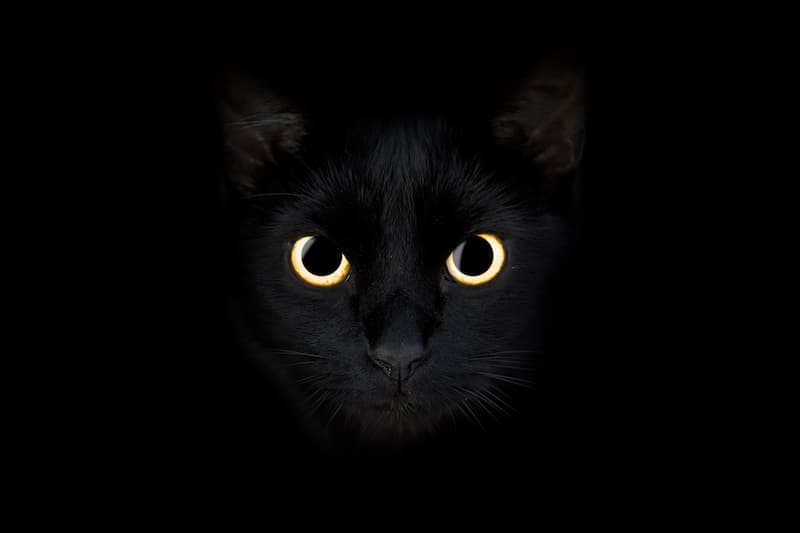
Ever watched your cat confidently navigate a dark room while you’re fumbling around for the light switch? It turns out they’re not secretly equipped with night-vision goggles. We’re solving the conundrum once and for all so you’re no longer left in the dark…!
Can cats see in complete darkness?
No. Cats can’t see in complete darkness because, just like human eyes, their eyes need some light to form an image.
What makes cats special is how efficiently their eyes use the light that’s available. Their eyes are designed to work particularly well in dim conditions, which means a room that looks almost pitch-black to us may still contain enough light for a cat to see what’s happening.
And eyesight isn’t their only night-time superpower. Cats also rely on their hearing, whiskers and sense of smell to help them understand what’s around them when visibility is poor.
So while your cat may appear to have a built-in torch, there’s actually some clever biology behind it.
Why can cats see so well in low light?
There are three main features of a cat’s eyes that give them their impressive low-light vision.
1. Their pupils let in plenty of light
Take a look at a cat’s pupils in bright sunlight and you’ll see those distinctive narrow vertical slits. In low light, those pupils can expand dramatically, allowing more light to enter the eye.
More available light means more information for the retina to work with. It’s one reason you’ll often see a cat’s pupils become huge when the room gets darker.
This graphic is a great representation of a cat’s eyes in different light, thanks to Cats Best:
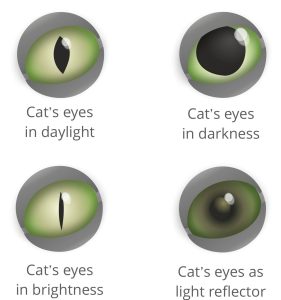
📸 credit: catsbest.eu
2. Their eyes contain lots of rod cells
The retina contains light-sensitive cells called rods and cones.
Rods are particularly good at detecting light in dim conditions and detecting movement. Cats have a high proportion of rod cells, which helps them see when there isn’t much light around.
This is especially useful for an animal whose ancestors hunted during periods of low light, when spotting movement could make the difference between dinner and going home hungry.
3. They have a tapetum lucidum
Here’s where things get really interesting. Cats have a reflective layer behind the retina called the tapetum lucidum. It reflects incoming light back through the retina, giving the light-sensitive cells another opportunity to detect it.
This helps cats make better use of the limited light available in their surroundings.
It’s also responsible for one of the most recognisable features of feline night vision…
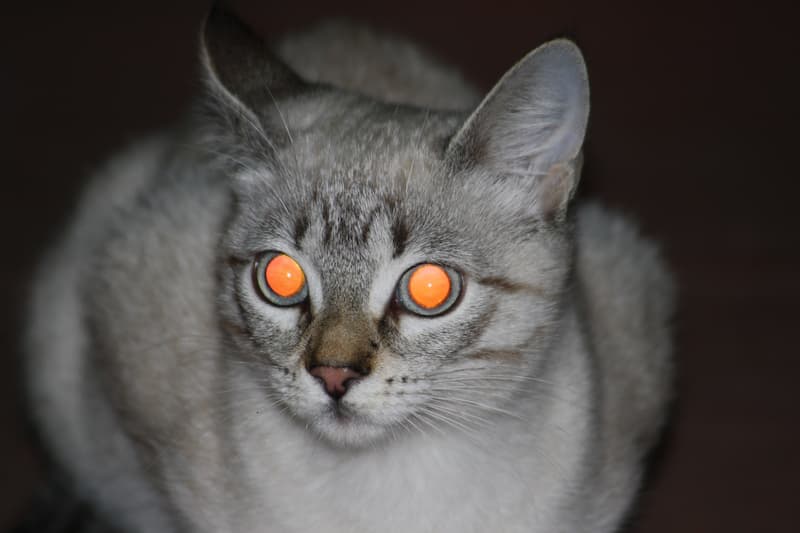
Why do cats’ eyes glow in the dark?
Those eerie glowing eyes aren’t your cat activating stealth mode. They’re caused by the tapetum lucidum reflecting light.
When light from a torch, car headlights, camera flash or another source enters a cat’s eye, some of it is reflected back towards the source. That’s why a cat’s eyes can appear to glow when they’re caught in a beam of light at night.
The colour of the eye-shine can vary between cats and depending on the angle and lighting conditions.
So the next time you see two glowing dots staring at you from the other end of the hallway, there’s no need to panic. It’s probably just your cat wondering why you’re awake at 2am!
Can cats see better than humans at night?
Yes, cats have significantly better low-light vision than humans. But that doesn’t mean cats have better eyesight in every way.
Their eyes are highly specialised for making the most of dim light, while human vision is better suited to seeing fine detail and a broader range of colours in brighter conditions.
Think of it less as cats having “better eyesight” and more as their eyes having a different set of priorities.
What do cats actually see at night?
Cat vision isn’t simply a brighter version of human vision.
In low light, cats are particularly good at detecting movement, shapes and contrast. This is useful for navigating their surroundings and spotting potential prey.
Their vision also becomes less reliant on colour as light levels fall.So if your cat is staring intently into a dark corner, they may be picking up on movement or subtle changes in light that you simply can’t see.
…Or there may be absolutely nothing there. We tried to interview a few felines but alas, cats remain frustratingly unwilling to clarify!
What we do know: A cat’s ‘night vision’ does not equal supernatural darkness vision.
Can kittens see in the dark?
Not at first. Kittens are born with their eyes closed, and their vision develops during their first few weeks of life. Their eyesight continues to mature as they grow, so a very young kitten doesn’t have the same visual abilities as an adult cat.
Once their vision has developed, kittens gradually gain the low-light abilities that make adult cats such impressive after-dark navigators.
Can older cats see in the dark?
Older cats may not see as well as they once did. Ageing can bring changes to a cat’s eyes and vision, and some cats may develop conditions that affect their ability to see in low light.
If your older cat suddenly seems reluctant to move around in dim rooms, bumps into objects, misses jumps they would normally make or seems disoriented, it’s a good idea to have their eyes and vision checked by a vet.
Are cats nocturnal?
Not exactly. Cats are crepuscular, which means they’re particularly energetic at dawn and dusk. This is a hangover from their days living and hunting in the wild, as their prey were equally active at these times. As a result, you or your trusted Cat Sitter may notice your cat playing more in the early morning or evening!
Domestic cats can adjust their routines around their environment and the people they live with. And some cats are simply more enthusiastic about late-night activity than others.
So if your cat decides that 2am is the perfect time for a sprint through the hallway, or venture outside and result in your neighbours complaining about your cat, their night vision certainly isn’t going to hold them back!
Can certain cat breeds see in the dark better than others?
To answer this question, we need to return to that “mirror” we mentioned earlier. In most cats – that is, those with green, hazel, or brown eyes – the tapetum lucidum emits a silvery-green glow whenever it’s reflecting light. In blue-eyed felines, though, it emits a more reddish glow. This is because their tapetum is slightly abnormal. Experts suspect this abnormality means they can’t see quite as well in the dark.
Cat breeds that can have blue eyes include the Balinese, Himalayan, Birman, Siamese, Ragdoll, Turkish Angora, Turkish Van, and Persian. It’s very possible that these breeds may not be as good at navigating low light as other cats.
Frequently Asked Questions:Can cats see in complete darkness?No. Cats need at least some light to see, but they can make much better use of very low levels of light than humans can. Do cats have better night vision than humans?Yes. Cats have eyes that are specially adapted to low-light conditions, including large pupils, many light-sensitive rod cells and a reflective layer called the tapetum lucidum. Why do cats’ eyes glow at night?A reflective layer called the tapetum lucidum reflects light back through the retina and towards the light source, creating the characteristic glow you see when light hits a cat’s eyes in the dark. Do cats need a night light?Most healthy cats don’t need a night light. They can generally navigate familiar surroundings in low light, although additional lighting may be helpful for cats with vision problems or age-related changes. What colours can cats see?Cats can see colour, but they don’t distinguish the same broad range of colours as humans. Their vision is particularly well suited to detecting light and movement, especially in low-light conditions. Should I worry if my cat suddenly struggles to see at night?Yes. A sudden change in your cat’s ability to navigate in low light, particularly if they’re bumping into objects or becoming disoriented, can indicate a change in their vision. It’s worth discussing any noticeable change with your vet. |
One thing’s for sure, though: cats are definitely better at operating in low light than dogs. (Wondering, “Can dogs see in the dark?” We’ve got all the answers!) Sorry, dog-lovers!
